Search This Blog

Monday, July 27, 2026

Dancing in the Glory of Monsters: The Collapse of the Congo and the Great War of Africa Congo Crisis 1

 Dancing in the Glory of Monsters 

The Congo Part 1

The Congo Crisis 

What is officially known as the Congo Crisis began in 1960 and ended in 1965. This is an arbitrary date that centers the conflict in the transitional years following Congolese independence from Belgium and the dictatorial rule of Mobutu Sese Seko. The decrepit corpse of the Congolese government and sovereignty that the Belgian government left the local Congolese resulted in a disintegration of institutions. When the Belgians left, they took their governmental officials with them; they took all the educated bureaucrats they had, and a vacuum ensued, only to be filled by Warlords and multinational conglomerates. The ethnic fissures within the country and government only became more pronounced. 

Patrice Lumumba, the first Congolese Prime Minister, was immediately put into the maelstrom of the brutal realities of Cold War politics.  Expressing Soviet appreciation stoked the ire of already integrated Belgian and Western influences. His government lacked the means to define itself and teetered. He was kidnapped and assassinated, no doubt through the intelligence gathered by Western countries. 

The more Western-allied Joseph Kasa-Vubu was elected as president, a role that was more ceremonial than the prime minister. Kasa-Vubu was heavily supported by the Belgian government, which saw him as restraining Lumumba. 

Following the Assassination of Lumumba and the dissolution of his government, rebellions only compounded. Although UN forces were glad to help, stem these rebellions. Kasa-Vubu was installed as having supreme authority following Lumumba's demise, but was ultimately deposed in a coup by Mobutu Sese Seko in 1965 after his government found itself in a standstill. 

On Mobutu

Mobutu was chief of staff of the Congolese army during Lumumba's government which helped him consolidate power in the military and maintain influence on the security forces. 

Mobutu became the emblematic corrupt African dictator. His country was buoyed by Western donations who in turn were given mining contracts. From 1965-1997 he ruled the Congo with the sole political party, Mouvement Populaire de la Révolution. In 1971 he changed the name of the country from the Democratic Republic of Congo to Zaire. This was part of a large-scale political policy called Zairization, also known as Authenticité which set out to establish a national identity for the Congo by exorcising elements of imperialism and colonialism. The policy did little to help the local population and mostly concerned trivial changes such as replacing Christian and European names with Congolese names; the Congo--> Zaire, mandating a Maoist-style dress code, and stemming the influence of the Catholic church. 

Mobutu ran his country into the ground yet maintained power by ruthlessly suppressing opposition; engaging heavily in cronyism and nepotism, allowing his own clan many of the top roles in his government; and promoting a pervasive cult of personality in which absurd myths and anecdotes about him would proliferate, giving him the aura of a "Great Man."

He owned chalets in Switzerland and mansions on the French Riviera among other real estate properties. His wealth was estimated at 150 million.  

Ironically, he was overthrown and fled the country in 1997, after his support of the Hutu refugees during the Rwanda Genocide led to an invasion by the Rwandan Patriotic Front. 

More on That...


Wednesday, June 10, 2026

King Leopold’s Propaganda War


King Leopold’s Propaganda War

On May 10th, 1897, within the grand Parc du Cinquantenaire of Brussels, the white-bearded and burly King Leopold II of Belgium inaugurated the opening of the 1897 World Fair.

The Fair was divided into two main areas, the main one in the Parc du Cinquantenaire and another fairground, connected by an electric tram in the suburb of Tervuren. In the main grounds of the fair, spectators marvelled over recent innovations in industrial production, electrical innovations, architecture, infrastructure, and design, many of which showed Belgium’s burgeoning Art Nouveau style. The main site was given a cultural and sophisticated taste. 

The Tervuren site, 10 kilometers away, had a different flavour. The site showcased exotic objects, animals, and goods such as cacao, stuffed chimpanzees, gazelles, and crocodiles, among other animals, and the mesmerising ivory elephant tusks. Grand lush landscapes replete with exotic plants and trees decorated the grounds, but the visitors were not the only ones who found themselves transported to a new world. Within the exhibition grounds, a carefully crafted African village was displayed. Congolese people, often sitting inert in their alien surroundings, were displayed in a sham village; many of them didn’t survive their time in Belgium. 

The Tervuren site was a demonstration of King Leopold’s personal project of the Congo Free State, an African land 70 times the size of his European nation. The exhibition was filled with propaganda that emphasized the civilizing mission of the Belgian influence in the Congo. By this time, Leopold had withstood criticism of his ownership and the brutality of his regime in the Congo, but in the following years, the exposure of the barbarous nature of his regime would become unavoidable. This is the story of how the extensive Propaganda network of King Leopold II managed to portray the Congo Free State as a humanitarian project when infact, it was one of the largest abuses of human life of the century. This is a story of two wars, one against the Congolese people, and another against the reality of the Congo Free State’s representation through propaganda.

The Builder King

King Leopold II was Belgium’s second King. The Kingdom had been formed in 1830 after the predominantly Catholic southern provinces of the Netherlands gained independence. Insecure of his Kingdom’s meagre size in comparison to nearby established European powers, Leopold II looked abroad to expand his wealth and influence.

From an early age, Leopold took an interest in commerce and geography. He was particularly captivated by the exploits of the explorer Henry Morton Stanley, whom he contracted to explore and develop trading posts in the Congo Basin. To veil his colonial aspirations, Leopold founded the International African Association, an ostensibly international association aimed at “organizing the scientific exploration of the still unknown regions of Africa, of opening up paths to civilization, and of seeking the means of gradually extinguishing the traffic in slaves.

Gradually, the Organization pivoted to focus more on the Congo Basin, continuing to espose it’s justification through esposing the three Cs of civilization, Christianity, and commerce.

Patches of Arab and Muslim states scattered throughout Africa, many of them, particularly in Eastern and Sub-Saharan Africa, had been much more integrated with the local populations than the more recent waves of European merchants. 

These predominantly Islamic states were designated as a common enemy to the European colonial ambitions. Through the rhetoric of ending slavery, and promoting Christianity, Africa was seen as a continent that needed liberation, and missionaries, many being honest and genuine in their mission sought to achieve this goal. But to the burgeoning imperial ambitions of the European powers, the goal was, as always one of commerce and enrichment.

Leopold understood this best and masqueraded his colonial ambitions in as a humanitarian and liberating force. His ploy proved effective, In 1885, during the conclusion of the Berlin Conference in which European powers carved the map of Africa to their liking, Leopold's Association emerged as the Congo Free State, a Belgian-run nation with free trade that encompassed what is now the Democratic Republic of Congo. Fearing heightened tensions between European powers over the vast lands of the Congo, on February 26th, in concluding the Berlin Conference, the European powers agreed to recognize the Congo Free State. 

Most important to the Europeans, of course, was that the State was a free trade zone, yet the State failed to enforce this and discriminated against non-Belgian trade. 

Tusks and Bones

The word ‘ivory’ rang in the air, was whispered, was sighed. You would think they were praying to it. A taint of imbecile rapacity blew through it all, like a whiff from some corpse.

The commodity that was most sought after in the Congo were the long bone white tusks of elephants that roamed the forests and savannas of the Congolese interior. 

It was used for various ornaments and furnishings among the European elite. Once Leopold was granted his corporate project, the exportation of ivory accelerated with estimates as high as 200 tons a year. Agents and traders were incentivized to extract as much as they could.

Integral to the extraction of ivory was the systematization of the Congo Free State's military, the Force Publique.  

The Force Publique consisted Belgian officers and mercenaries from other countries. In order to grow their ranks, the military enacted an aggressive and coercive enlistment of local Congolese into the force. Many locals saw joining the force as more favorable than falling victim to the violent and oppressive measures the Force Publique enacted to extract resources. Villages were ordered to produce quotas of ivory, and if they failed to meet these demands or refused, significant repercussions would be met.

Villages were often burned, women, children, and village chiefs were held hostage, and people were whipped often to death with the brutal hippopotamus-hide whip, the chicotte. 

The invention of air-inflatable tires by Scotsman John Boyd Dunlop increased the already significant global rubber demand and added another significant and destructive commodity to be extracted from the Congo. The rubber terror swept through the land, and the same brutal and inhumane measures in resource extraction for ivory became even more widespread.

The brutality of the Force Publique coupled with the vast interior jungle of the Congo caused attrocities to spread like wildfire, as indiscriminate violence spread. 

The Propaganda War

It did not take long for observers to condemn the inhumane practices in the Congo. Missionaries wrote to Leopold and Belgian officials about the atrocities, but their pleas were either ignored or responded to by a feigned concern and hollow promises of reform. Those who leaked information to the press rather than directly to Leopold and his officials were intimidated and silenced. 

George Washington Williams and William Sheppard, two African Americans, the former a writer and historian, the latter a Presbyterian missionary, became Leopold's most obstinate early critics.  Williams wrote in an open letter to the King that the regime committed “crimes against humanity”, while Sheppard detailed the massacres of villages. Leopold tried to silence Sheppard and Williams, but it would not work; they remained obstinate in their perceptions of the Free State of Congo, but being Black, they were largely slandered and ignored in Europe.

Leopold’s extensive network of diplomats and propagandists was prepared. With his title, wealth, and his tactful association with various associations and societies concerning Africa, he had considerable power and leverage.

Leopold funded newspapers to give the Free State favorable coverage. He allowed for two narratives: one that the Congo Free State was a humanitarian mission dedicated to ending slavery and civilizing the local population; the other that the state had problems but these were isolated incidents often exaggerated by critics and that the King was adamant in stamping out atrocities that blighted his State.

Carefully crafted tours of the Congo controlled well by the State were provided to few foreign observers. One of which, the writer Mary French Sheldon declared "I have witnessed more atrocities in London streets than I have ever seen in the Congo."

The king also cultivated relationships with Catholic missionaries and instutions often portraying himself as a victimized Catholic. Petitioning the Vatican numerous times to purchase Congo Bonds to help the spread Christianity.

When news about the atrocities mounted, Leopold formed “The Commission for the Protection of the Natives,” an advisory body stationed in the Congo to investigate the atrocities composed of 6 prominent missionaries, half Catholic, half foreign and Protestant. 

The European press commended Leopold and believed that he meant what he said when he vowed to stop the atrocities.

But the commission was ineffective and poorly funded; they were not given the means to travel deep into the Congo, where much of the rubber terror was, and they were instructed to report their abuses to the Congo State authorities.


But by 1900s, the writings of Williams, Sheppard and others became amplified by the work of E.D. Morel. In 1890s, the young Morel worked as clerk with the shipping company Elder Dempster, and witnessed firsthand ithe enourmous quantities of ivory and rubber that came from the Congo to Antwerp, while guns and shackles were shipped out. Morel became convinced that the stories told were true and that the people of the Congo were indeed being plundered and enslaved. He began writing about these trade discrpecies and when he voiced them, he was swiftly repremended by his Boss, who happened to be bribbed by Leopold.


Dedicating himself fully to exposing the atrocities, Morel founded the journal West African Mail, where he compiled testimonies from just about anyone who had something to say about the Congo. He cultivated a network of contacts in Belgium, Britain, and the Congo, and uncovered many of Leopold's

In 1904 Morel founded the Congo Reform Movement, and activism spread globally and coalesced. Drawing support from the United States and the United Kingdom, the organization used pamphlets, public lectures, political lobbying, and photography to challenge Leopold’s carefully constructed narrative. Among the most influential allies of the reform movement, which included the likes of Mark Twain and William B Du Bois, was Roger Casement, the British consul whose official 1904 report confirmed widespread forced labor and violence. His findings lent governmental credibility to the accusations.

By 1904, the gruesome photographs of Alice Seeley, a British missionairy became well known around the world; the maimed hands and murdered bodies could not have been staged. 

Leopold, among growing pressure from his own parilement appointed a commission to investigate the abuses reported in the Congo. To Leopold's dismay, the results of the commission became public, and the widespread nature of the atrocities of the Congo Free State was confirmed. Undermounting pressure, after lengthy legal proceedings Leopold sold the Congo Free State to the Belgian government in 1908 for a hefty sum. He died in 1909. 

Leopold’s Legacy 

Outside of the Royal Palace of Laeken, is an immense greenhouse, housing impressive collections of cammelias, geraniums, azeleas and palm trees that reach for the sky. 

The Greenhouse was one of the many projects Leopold commissioned and built with funding he acquired from revenues from The Congo Free State. And like many of his projects their was an element of controlled exoticism from the Congo. 

Leopold had never set foot in the Congo. He never looked at the atrocities of the country in it's face. Rather he imported the Congo that he wanted to see, one of exotic plants, animals, artificats and goods. He saw a Congo that could be used to extensively fund his lavish building projects and lifestyle. 

As the Congo Propaganda War took place, the Congo itself resembled a warzone. Though the efforts of the Congo Reform movement brought light to the attrocities commited in the Congo and stemmed their propagation the region would continue to suffer from instability. Systemic violence still plagues the region as roving bands of militias terrorize the country most notably in the mineral rich Kivu area. 

The legacy of Leopold’s rule is not confined to the past. The structures of extraction he helped establish remain one of the defining challenges of the modern Democratic Republic of the Congo and are a window into the problems that plague many African nations. 

Saturday, February 28, 2026

Les Misérables, Tom Hooper 2012

There are emotive performances by Hugh Jackman and Anne Hathaway, but the singing is often poor (Crowe is as awkward as a trombone playing in a woodwind orchestra). 

The cinematography and editing are a drunken hellscape, shifting disorientedly from slanted to close-ups to tracking shots, and hurl-inducing shaky cams. 

The scenes shift at such a fast pace of set expositions like a continuous string of advertisements attempting to sell the film. The neurotic melodrama verges on emotional torment. 

5/10


Frankenstein, Guillermo del Toro 2025

 Frankenstein, Guillermo del Toro 2025


The Gothic sheen can feel too cloying  typical of Netflix productions, and del Toro is scarcely on the nose. His sets and costumes inundate. The script often feels cliché and predictable, and many significant characters such as Isaacs' and Waltzs' feel hollow, and their performances of Isaac suffer from it. Dr. Frankenstein (Isaac) garners a modicum of sympathy from his childhood trauma, but this is quickly evicerated. In his adult ages he is just a narcissist with not a thought for life, strange for someone of his profession.

The movie picks up when the Monster emerges, though many cliches remain. The film often flirts admirably with Paradise Lost, and emphasizes the parallels. Elordis's eyes steal the show.

6/10 

Wednesday, September 17, 2025

A History of the World Book #1 Before History


A History of the World Book #1 Before History 

Before agriculture, history is long, very long and dark and murky. The basics are as follows

Humans diverged from great apes (chimps and bonobos) approximately 6-7 million years ago.

Australopithecus, is known as on of the earliest hominids, they were bipedal and found in eastern and southern Africa. They emerged around 4 million years ago.


Then Emerges Homo Habilis 2.4 million years ago. This species had a bigger brain and could use tools.


From this came Homo Erectus 1.5 million years ago, they had similar body proportions to modern humans, used tools and were the first to control and manage fire. This allowed them to manipulate their environment. This was though, a long process and actually learning how to make fire took time.  They expanded to the Near East and Asia. They engaged in big game hunting and used stone tools.
A distinction between male and female was made stronger in cultural life and reproductive life as females stopped entering in estrous cycles (entering in heat, activitly seeking a male). This made sexual selection a reality. 


Homo Neanderthalensis (named after a skeleton was found in the Neander Valley in Germany) emerged about 400,000 years ago and spread through much of Europe.

They were shorter but stockier. They had smaller frontal lobes than Homo Sapians but larger Occipital lobes, which benefited being big game hunters which they were. Their is evidence that they buried the dead some times. 

They seemed to maintain a low population and interbred. This made them very easily supplanted by Homo Sapians in 40,000 BC. 

Denisovans were a subspecies similar to Neanderthals who lived mostly in South East Asia. Most humans have some Neanderthal or Denisovan DNA.

Homo Sapians emerged from Africa around 300,000 years ago. 
They began to develop advanced cognitive skills, social cordination, burial of the dead, seafaring, toolmaking and the arts among other skills. Language developed but it's origins remain murky


They lived as hunter gatherers until 12,000 BC when the agricultural revolution took place (Neolithic Revolution). The revolution happened independently in many regions in the world where it was possible. 


Following the Agricultural Revolution, trade routes were established, travel was made easier through the usage of domesticated animals, and most importantly, societies could begin as you did not need a lot of space or to be nomadic to produce a lot of food. The Bronze Age began. 


Friday, September 5, 2025

7 Words and Their Origins, Vol 2. The Sun

7 Words and Their Origins, Vol 2. The Sun

1) SunOrigin: From Old English sunne, related to Proto-Germanic sunnōn, and ultimately from Proto-Indo-European sóhwl, the root for “sun” across many Indo-European languages (e.g., Latin sol, Greek helios).

2) SolarOrigin: From Latin solaris, meaning “of the sun,” from sol, “sun.”

3) DawnOrigin: From Old English dagian, meaning “to become day.” Related to the word day, both deriving from Proto-Germanic dagaz.

4) EclipseOrigin: From Greek ekleipsis, meaning “abandonment” or “failing to appear.”

5) ParasolOrigin: From French parasol, literally “sun-shield,” from para- (to protect) + sol (sun). Entered English via French and Italian. 

6) RiseOrigin: From Old English rīsan, meaning “to go up, rise, or ascend,” from Proto-Germanic rīsaną

7) GoldOrigin: From Old English gold, from Proto-Germanic gulþą, possibly from a root meaning “to shine” or “yellow,” 


Friday, July 18, 2025

7 Words and Their Origins, Vol 1. The Sea

7 Words and Their Origins, Vol 1. The Sea

1) Ocean Origin: From Latin ōceanus, via Greek ōkeanos, meaning “a vast or large body of water.”

2)Island Origin: From Old English īegland, meaning “island.” The s was added in the 16th century under the influence of isle (which previously lacked an s), and then carried over to island.

3)Tide Origin: From Old English tīd, meaning “time, season, or period,” etymologically related to “time.”

4)Drown Origin: From Old English druncnian, meaning “to sink or be submerged in water.” Shares its root with drunk.

5)Azure Origin: From Old French azur, from Arabic lazaward, meaning “lapis lazuli” (a blue stone).

6)Shark Origin: Borrowed into English between the 14th and 16th centuries from German Schurke, meaning “villain.”

7)Profound Origin: From Latin profundus, meaning “deep” or “bottomless.”


The Child

The Child

            My courage is mine, and mine alone.

Its pulse and breath, weighed by stone.

A rose, a cross, a heart bled bare,

Enclose the infant and rightful heir.


These eyes that paint my world around,

And the sounds in which my name is bound,

Come from an ocean vast unknown,

But they are mine and mine alone.


My darkness too is within my breast,

And has etched designs without rest.

Groping, clawing onto my veins,

Its sorrow speaks in twisted chains.


But deep within my bloody streams,

Swims the child of ancient dreams.

Whose flaming voice chars the bone,

And claims this life as mine alone. 

Tuesday, December 31, 2024

The Boer Wars

The Boer Wars were two wars fought between the South African Boers (Farmers) and the British Empire.

Who Were the Boers?

"Boer" (pronounced "bu-ruh") is the Dutch and Afrikaans word for "farmer." The Boers were settlers of French (Huguenot), German, and predominantly Dutch origin who began settling in South Africa during the period of the Dutch Cape Colony. They established a settlement at present-day Cape Town in 1652 under the Dutch East India Company (VOC).

From the outset, the Boers interacted with various local African groups, including such as the Khoikhoi, San and Xhosa

The British Empire always had an eye on the location, recognizing the strategic importance of the Cape as a maritime waypoint to India, and sought control of the region early on attempting to establish a settlement near Capetown. Although the Dutch established their presence in 1652, British merchants continued to use the Cape for trade.

During the Napoleonic Wars, the British formally seized the Cape Colony in 1806, motivated by the Netherlands’ alliance with France under Napoleon. In 1814, the Treaty of Vienna ceded the Cape to Britain permanently.

The Great Trek and the Voortrekkers

The Boers took issue with many of the British and felt alienated. The British abolished slavery in 1834 disrupting the Boer economy. The Afrikaaners felt culturally alienated from the British as well.

A map of the world

AI-generated content may be incorrect.

This dissatisfaction led to the Great Trek (1830s-1840s), a mass migration of Boer families, known as the Voortrekkers (“pioneers”), into the South African interior. The Voortrekkers sought autonomy and new lands for farming, free from British interference.


Long shot of a wagon

AI-generated content may be incorrect.

Development of the Boer Republics

Following the Great Trek, the Boers established independent republics: Transvaal (South African Republic) and the Orange Free State: Established in 1854.

These republics were predominantly agricultural and fiercely independent, existing in uneasy proximity to British-controlled territories.

First Boer War (1880-1881): The discovery of diamonds in Afrikaaner lands lead to increased British interest. British Empire attempts to annex the Transvaal which provoked resistance, the Boers waged guerrilla war successfully and the Biritish allowed the South African Republic to regain self-government under British suzerainty.

A group of men shooting horses

AI-generated content may be incorrect.

Second Boer War (1899-1902): Tensions escalated over control of gold and diamond resources in and influxes of gold searching immigrants in Afrikaaner lands stoked tensions.  Boer territories, as well as British imperial ambitions.

Diplomatic tensions escalated following the failed Jameson Raid in 1895 spearheaded by colonialist adventurer Cecil Rhodes.

The inevitable war began in October 1899, when the Boer republics declared war on Britain after British troop buildups near their borders. In the early stages, the Boers used guerrilla tactics and besieged key British towns, achieving several successes. 

The Boers were much more efficient fighters, however eventually the British overpowered them through an influx of soldiers and from the crown. The British eventually adopted scorched-earth tactics burning farms and using the British burned farms and used concentration camps to control the Boer civilian population, where tens of thousands of civilians, particularly women and children, died due to poor conditions.

This was the first conflict in which barbed wire was extensively used, playing a strategic role bringing spaces under control, at military outposts as well as to hold the captured Boer population in concentration camps.

A group of soldiers in uniform

AI-generated content may be incorrect.


The war ended with the signing of the Treaty of Vereeniging on May 31, 1902. The Boer republics were incorporated into the British Empire, but the treaty promised eventual self-government, leading to the formation of the Union of South Africa in 1910. 


Sunday, November 17, 2024

When Alexander the Great Met Diogenes the Cynic

The year is 336 B.C. The place is the Greek city-state of Corinth in the suburb of Craneion and the sun was shining bright when Alexander III of Macedon met Diogenes the Cynic. Their interaction would spawn numerous paintings and philosophical and literary reinterpretations. Let’s introduce these two figures of antiquity.

Alexander III of Macedon

In one corner, Alexander III of Macedonia. This was the year that his father, King Phillip II, was assassinated, and he ascended as ruler of the Macedonian empire.

He is twenty years old and already a formidable military figure. Standing at an average Ancient Greek height of 5 feet, he is stocky and has a fair complexion and medium-length hair. He is average-looking physically, but well-built and dressed not only as a king with a cape but in the armor of a conqueror.

Alexander is going on a tour of city-states, accepting oaths of fealty and has reached Corinth. He is already the most powerful man in Greece and is in the process of unleashing a tidal wave of conquest that will envelop much of the Middle East.

Alexander and his procession are marching down the streets of Corinth. Statesmen, philosophers, and common citizens grovel and congratulate their new king. However, one man remains unfazed by the cavalcade. Lying on the floor in the afternoon sun is one of the most colorful philosophers of the city: Diogenes the Cynic.

Diogenes of Sinope

The second actor in this story is Diogenes of Sinope. He is the son of a banker of Sinope in modern-day Turkey. His father became embroiled in a scandal that likely involved counterfeit money and was banished from Sinope. It is likely that Diogenes himself was involved in his father’s business and was exiled. Making his way to Athens, Diogenes pestered the philosopher Antisthenes, an ascetic pupil of Socrates for his tutelage, and soon the two figures began developing the early streams of Cynic philosophy.

Diogenes is not a fan of Plato and thinks him to be too needlessly abstract, instead, to him and many of the Cynic philosophers virtue is promoted through action and harmony with nature. Social constraints and the desires that society imposes are to be rejected.

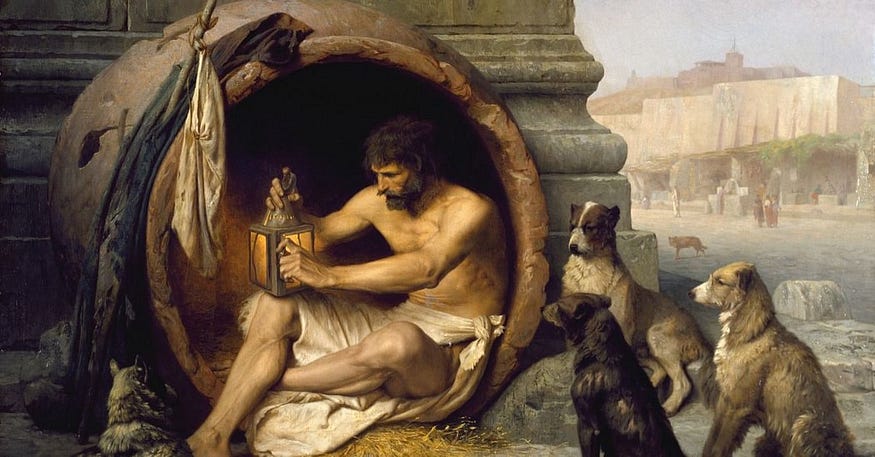
During this encounter, Diogenes is roughly seventy years old, wearing simple garments, he has rejected worldly possessions and chooses to live a life opposing society’s influence. Because of this, he does everything he needs to do in the streets.His only consistent abode was a ceramic tub, which he eventually destroyed because he thought it superfluous. He has several dogs to keep him company and often emulates their actions more than humans. Disheveled and dirty, Diogenes the Cynic is found in the streets of Corinth sunbathing when he is approached by Alexander and his posse.

Diogenes Sitting in His Tub|Jean-Léon Gérôme, 1860

The Encounter

Alexander the Great, likely slightly discontented that one of the most prominent philosophers of this city had not paid him much notice, approaches the old man and declares “I am Alexander the Great King,” Diogenes looks up and responds, “I am Diogenes the Dog.”

Alexander then proceeds to ask Diogenes if he desires anything. Knowing that Alexander is the most powerful man he would ever meet, Diogenes replies, “Yes. I would like you to stand a little out of my sun.”

Alexander’s men proceed to hurl insults at the philosopher, but Alexander is reportedly so stunned by this interaction and in awe at Diogenes' attitude, that he later says to his close companions “But truly, if I were not Alexander, I wish I were Diogenes.”

Another version of the anecdote has Diogenes contemplating a pile of human bones. The philosopher says, “I am looking for the bones of your father, but I just can’t tell them from the slaves.”

Alexander and Diogenes|Gaetano Gandolfi, 1792

The Significance of the Interaction

During the Middle Ages, this anecdote gained considerable notoriety as the teachings of the ancient Greeks became more popular.

The duality between the two men is often highlighted in the interpretations, Alexander being a conqueror not satisfied till he conquers the world, while Diogenes the contented vagrant is satisfied with simple earthly pleasures. This event was used largely to demonstrate the material limitations of man.

Although Alexander could have probably given Diogenes anything reasonable, he could not give him the time Diogenes lost in the sun. However, this anecdote also shows Alexander as a tolerable and respectable king opting to praise and commend the philosopher for his virtue rather than reprimand him for his insolence, further cementing Alexander as a great king.

This interaction also gets interesting when you learn that Alexander and his followers would frequently refer to him as the son of Zeus. Coins with Alexander’s face also had the signature Herculean symbols of spiked clubs and lions etched to further his image as the mythical son of Zeus. This was not fully dishonest because during this period it was believed that the gods came down to earth and had children, and a sign that you were a descendant of a god was typical that you had good luck, which Alexander had in buckets.

However, when you translate Diogenes’s name from Ancient Greek it literally means born of Zeus. Alexander wanted to prove himself to the world through conquest and emulating the heroics of Achilles and Hercules, while Diogenes did not need anything to prove himself because his name already cemented that he had already attained a superior mode of contentment in his own life, one which Alexander was searching for.

Alexander and Diogenes as Dogs|Edwin Landseer, 1848

It must concluded that, like much ancient history, this anecdote is subject to debate regarding its veracity. Many believe that the anecdote is exaggerated, while some believe that it actually happened in India when Alexander interacted with the Gymnosophists, a group of naked ascetic philosophers. Still, the anecdote is a timeless demonstration of Diogenes’s Cynic philosophy and the limitations of material wealth and power.

Dancing in the Glory of Monsters: The Collapse of the Congo and the Great War of Africa Congo Crisis 1

 Dancing in the Glory of Monsters  The Congo Part 1 The Congo Crisis  What is officially known as the Congo Crisis began in 1960 and ended i...